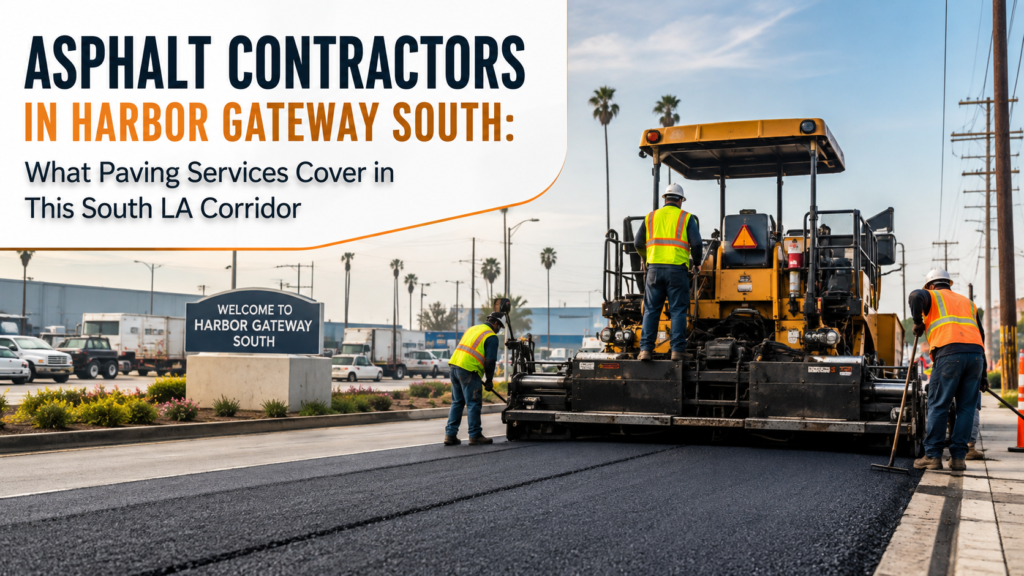
Harbor Gateway South is a narrow, heavily industrialized corridor in the southernmost tip of the City of Los Angeles, running between the communities of Gardena and Carson and connecting central Los Angeles to the Harbor area. Despite its modest residential population, the neighborhood hosts a dense concentration of industrial facilities, warehousing, light manufacturing, and commercial properties, all generating steady demand for professional asphalt paving and maintenance services. This guide explains what Asphalt Contractor Harbor Gateway South provide in Harbor Gateway South and why professional paving is essential in this uniquely demanding urban industrial environment.
What an Asphalt Contractor Does
Asphalt contractors specialize in the installation, resurfacing, repair, and maintenance of asphalt pavement the petroleum-based composite material used for driveways, parking lots, access roads, loading dock aprons, industrial yards, and road surfaces. A full-service asphalt contractor handles the entire lifecycle of an asphalt surface: designing the appropriate pavement section for the expected traffic load, preparing the subbase, installing new asphalt, maintaining the surface through sealcoating and crack repair, resurfacing deteriorated surfaces with overlay, and ultimately managing full replacement when a surface has reached end of life.
In an industrial corridor like Harbor Gateway South, the demands on asphalt surfaces are more intensive than in residential or light commercial settings. Heavy trucks semi-trailers, delivery vehicles, tanker trucks, and heavy equipment regularly traverse the driveways, access roads, and yard areas of industrial properties. This heavy vehicle loading puts far greater stress on pavement sections than passenger vehicles, requiring thicker asphalt sections, stronger subbase preparation, and more aggressive maintenance schedules than a typical residential driveway.
The Built Environment and Paving Demands of Harbor Gateway South
Harbor Gateway South’s character as an industrial and commercial corridor creates specific paving conditions. Truck traffic from distribution and logistics operations generates repetitive heavy axle loads that accelerate rut formation and fatigue cracking in asphalt. Industrial activities including fuel handling, chemical storage, and vehicle maintenance introduce petroleum products and solvents that attack asphalt binder the petroleum-based glue that holds asphalt aggregate together accelerating surface deterioration beyond what UV and traffic alone would cause.
Los Angeles’s climate adds thermal stresses throughout the year. Summer temperatures in the Harbor Gateway corridor regularly exceed 90°F, and black asphalt surfaces can reach surface temperatures of 150°F or higher under direct sun. At these temperatures, asphalt softens significantly, becoming more susceptible to rutting under concentrated wheel loads from trucks making tight turns in industrial yard areas. Southern California’s periodic El Niño rain events and the contrast between dry summers and wetter winters create moisture cycling that affects pavement edges and subbase conditions.
The industrial properties of Harbor Gateway South also frequently have access challenges that require paving contractors to work efficiently in constrained environments around active loading docks, within fenced security perimeters, adjacent to operational equipment and storage areas. Experienced Southern California industrial paving contractors understand how to manage these operational constraints while delivering quality results.
Asphalt Paving Services Relevant to Harbor Gateway South
New asphalt installation is the starting point for any paving project in Harbor Gateway South. Whether establishing a new loading dock apron, creating a paved truck circulation area in an industrial yard, or resurfacing a commercial parking lot that has deteriorated past the point of overlay, new installation involves excavation of existing material, subbase preparation to the depth and quality appropriate for anticipated traffic loading, and placement of asphalt in one or more lifts to achieve the specified section thickness.
For industrial and heavy commercial applications in Harbor Gateway South, subbase preparation is the most critical factor in long-term performance. Aggregate base course of 6 to 12 inches or more compacted to specified density and properly graded for drainage distributes concentrated truck wheel loads over the underlying subgrade. A pavement section that performs adequately for passenger vehicle traffic may show early structural failure under heavy truck loading if the subbase is insufficient. This is a common cause of industrial lot failure in the Harbor Gateway area.
Asphalt overlay and resurfacing addresses properties where the base is structurally sound but the surface has deteriorated through cracking, oxidation, or surface raveling. A mill-and-overlay approach grinding the surface to a consistent depth with a milling machine before applying new asphalt provides better bonding and geometric correction than simple overlay alone, and is increasingly the preferred approach for commercial and industrial resurfacing in Southern California.
Sealcoating protects existing asphalt from the sun, rain, and petroleum product exposure that is common in industrial Harbor Gateway South settings. A quality coal tar or asphalt-based sealcoat applied every two to three years on heavy commercial lots slows oxidation of the asphalt binder and resists fuel and oil spill penetration that would otherwise accelerate surface deterioration.
Crack sealing with rubberized joint sealant prevents water infiltration through surface cracks into the pavement base, stopping one of the primary deterioration mechanisms in Southern California’s wet season. Parking lot striping applying traffic management markings, parking space lines, ADA accessible space symbols, fire lane designations, and directional arrows completes commercial lot projects and is required by Los Angeles County and City building codes for commercial properties.
ADA Compliance in Harbor Gateway South Paving Projects
Commercial properties in Harbor Gateway South that provide parking or pedestrian access are subject to California’s accessibility requirements under the Americans with Disabilities Act (ADA) and the California Building Code (CBC) Title 24. Paving projects that alter or establish parking areas, access aisles, pedestrian pathways, or building approach routes trigger ADA compliance review, requiring that accessible parking spaces meet dimensional standards (minimum 8-foot parking space with 5-foot access aisle for standard accessible spaces, 11-foot space with 5-foot aisle for van accessible spaces), that surfaces meet slope requirements (maximum 2% slope in any direction), and that pathways from accessible spaces to building entrances are free of obstacles.
Los Angeles Department of Building and Safety and Los Angeles County inspection programs actively enforce accessibility requirements on commercial properties. Asphalt contractors who understand ADA compliance standards and who design their pavement layouts, grades, and accessible space configurations to meet California requirements protect their commercial clients from compliance risks and future enforcement exposure.
Frequently Asked Questions About Asphalt Contractors in Harbor Gateway South
How thick should asphalt be for a heavy truck area in Harbor Gateway South? For regular heavy truck traffic (semi-trailers), a total pavement section of 10 to 14 inches is typical in the Los Angeles area usually 4 to 6 inches of asphalt over 6 to 8 inches of compacted aggregate base. Specific thickness is determined by a pavement design based on the subgrade soil bearing capacity and anticipated traffic loading.
Does paving in Harbor Gateway South require a permit? Most paving projects on private property in Los Angeles do not require building permits for the paving itself, but work affecting public sidewalks, curb cuts, or the public right-of-way requires an encroachment permit from the Los Angeles Bureau of Engineering. ADA accessibility modifications may also require permit review.
Why does asphalt on industrial lots deteriorate faster than residential driveways? The primary factors are heavy vehicle loading (which causes fatigue cracking and rutting at a rate far exceeding passenger vehicles) and petroleum product exposure from spills, leaks, and tire track contamination that chemically attacks the asphalt binder. Industrial lot asphalt requires more frequent maintenance and thicker pavement sections than residential applications.